This is more than just a series of products; it is an ecosystem we have built to achieve a more efficient, reliable, and sustainable energy future. Discover how our products and solutions can create t...
Our Industrial Batteries combine high-quality materials, robust design, and dependable performance. With excellent deep-cycle capability and easy maintenance, they are ideal for diverse applications. ...
JYC Transportation batteries are a category of power storage devices specifically designed for transportation scenarios, with core functions of providing continuous, stable, and high-efficiency power ...
JYC Motive Power batteries are deep-cycle energy storage devices specifically designed for industrial and commercial vehicles and specialized equipment. Their core function is to provide continuous an...
Based on the low-carbon concept, and thanks to the competitiveness of energy storage technology, lithium applications in various systems will be gradually realized globally. JYC Lithium Battery Soluti...
Focus on company news, product updates and market events. We provide continuous updates to bring you first-hand information, helping you stay informed about our development progress at all times.
CCA vs Reserve Capacity: Critical Metrics for Heavy-Duty Fleets
2026-01-28 13:25:13
Key Takeaways
CCA (Cold Cranking Amps) measures the burst power available to start an engine at 0°F (-18°C), essential for cold climates and massive diesel engines.
RC (Reserve Capacity) indicates how long a battery can sustain a 25-amp load before voltage drops, critical for powering "hotel loads" (sleepers, GPS, liftgates) when the alternator is off.
Modern heavy-duty fleets are shifting focus from pure CCA to higher RC due to anti-idling laws and increased onboard electronics.
AGM and Lithium (LiFePO4) technologies offer superior cycling capabilities compared to traditional flooded lead-acid batteries, bridging the gap between high cranking power and deep discharge endurance.
For decades, the commercial trucking industry operated on a single maxim regarding batteries: "More CCA is better." In an era where trucks were purely mechanical beasts with minimal electronics, the primary job of the battery was simply to turn over a massive 15-liter diesel engine on a freezing morning. However, the operational landscape for heavy-duty fleets has shifted dramatically.
Today, fleet managers face a complex equation involving anti-idling regulations, sophisticated telematics, and driver comfort amenities (hotel loads). This evolution has sparked a critical debate in preventative maintenance strategies: CCA vs. Reserve Capacity. Which metric truly dictates fleet reliability and Return on Investment (ROI)?
Cold Cranking Amps (CCA) Explained
To understand the trade-offs, we must first define the standard accurately. Cold Cranking Amps (CCA) is an industry-standard rating that defines a battery's ability to start an engine in cold temperatures. Specifically, it measures the number of amperes a lead-acid battery at 0°F (-18°C) can deliver for 30 seconds while maintaining a voltage of at least 7.2 volts (for a 12V battery).
Why CCA Still Matters
Despite the rise of electronics, the physics of an internal combustion engine remain unchanged. Diesel engines have high compression ratios and require significant torque to rotate the crankshaft. In cold weather, two factors compound the difficulty:
Electrochemical Slowdown: The chemical reaction inside a lead-acid battery slows down, reducing potential output.
For fleets operating in northern latitudes (e.g., Canada, Northern Europe, Northern US), high CCA is non-negotiable. If the battery cannot provide that initial surge current (often exceeding 1000A for large trucks), the truck stays grounded, resulting in missed delivery windows and costly jump-start services.
Reserve Capacity (RC) Explained
Reserve Capacity (RC) is the number of minutes a fully charged battery at 80°F (27°C) can be discharged at a constant 25 amps before the voltage drops below 10.5 volts. While CCA measures power (burst energy), RC measures energy (endurance).
The Rising Importance of RC in Logistics
Modern trucks are mobile offices and dormitories. The demand for Reserve Capacity is driven by parasitic loads and "hotel loads" that operate when the alternator is not spinning. These include:
Sleeper Cab Amenities: Microwaves, refrigerators, HVAC systems, and CPAP machines.
Telematics: GPS tracking, ELD (Electronic Logging Devices), and communication gateways that draw power 24/7.
Liftgates: Hydraulic lifts on delivery vans rely entirely on battery reserves during loading/unloading.
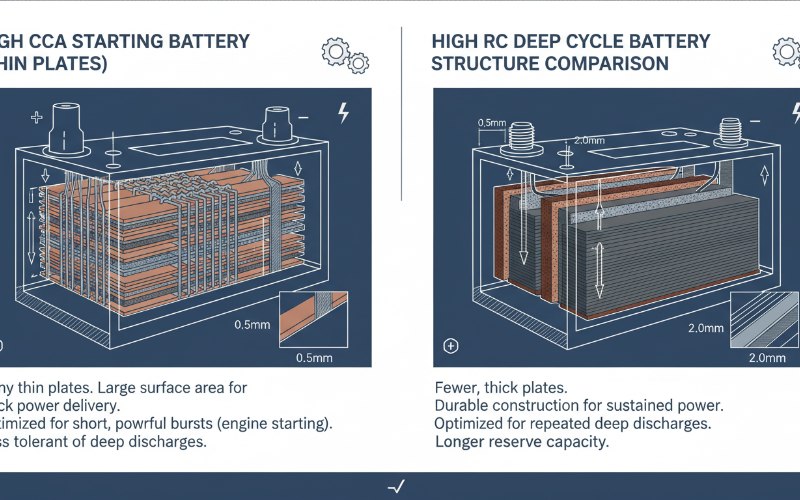
If a fleet prioritizes CCA but ignores RC, a driver might successfully crank the engine in the morning, drive to a rest stop, run the AC for 8 hours, and wake up to a dead battery. The high plate surface area required for high CCA often means thinner plates, which degrade faster under the deep cycling conditions of hotel loads.
Comparing Metrics: A Technical Breakdown
Fleet managers must analyze the operational profile of their vehicles. The table below illustrates the divergence in utility between these two critical metrics.
Feature
Cold Cranking Amps (CCA)
Reserve Capacity (RC)
Primary Function
Engine Starting (Ignition)
Accessory Power (Sustaining)
Test Load
Variable High Current (0°F)
Constant 25 Amps (80°F)
Internal Construction
Thin plates, high surface area
Thicker plates, high active material density
Critical For
Line-haul in cold climates
Sleepers, Liftgates, Stop-Start Traffic
Failure Mode
Failure to Crank (Slow Turn)
Deep Discharge Damage (Sulfation)
Battery Chemistry
Flooded / Standard AGM
Deep Cycle AGM / GEL / Lithium
The Impact of Battery Chemistry
The conflict between CCA and RC is largely a limitation of traditional lead-acid chemistry. However, advancements in Absorbed Glass Mat (AGM) and Lithium Iron Phosphate (LiFePO4) are changing the selection process.
1. Flooded Lead-Acid
Traditional flooded batteries are often designed specifically as "Starting" (High CCA) or "Deep Cycle" (High RC). Using a Starting battery for hotel loads causes rapid shedding of the active material from the thin plates. For fleets on a tight budget, these require strict maintenance and careful load management.
2. AGM (Absorbed Glass Mat)
AGM batteries provide a superior balance. The compressed plate structure allows for lower internal resistance (High CCA) while the glass mat separator supports the active material better during discharge (Better RC). For most mixed-use heavy-duty fleets, Dual Purpose AGM batteries are the standard recommendation to balance starting power with cycling durability.
3. Lithium-Ion (LiFePO4)
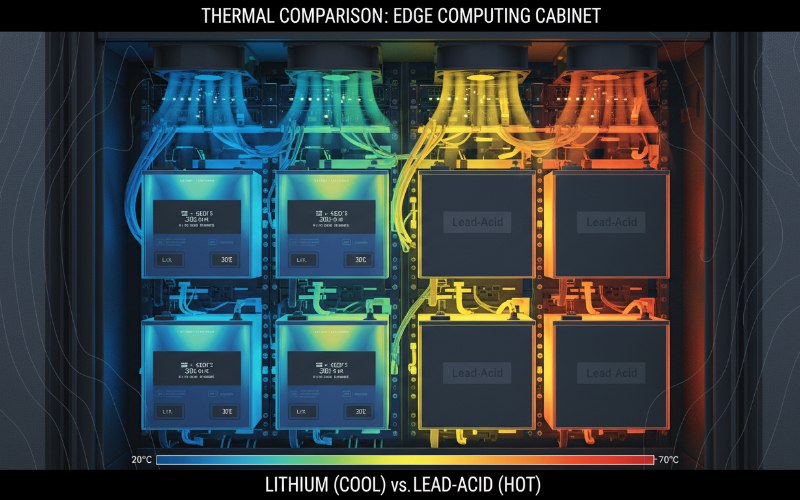
The lithium battery represents a paradigm shift. A LiFePO4 battery has a flat voltage curve, meaning it can deliver its rated power almost until it is fully depleted. While traditionally expensive, their Cycle Life (often 3000+ cycles vs 400 for lead-acid) and massive usable capacity make them the ultimate solution for high-RC requirements, such as electric Auxiliary Power Units (APUs).
Decision Guide: Which Metric Should You Prioritize?
To optimize fleet uptime, apply the following logic to your battery procurement strategy:
Scenario A: The Long-Haul Ice Road Trucker
Priority: CCA. If your trucks operate in sub-zero temperatures and spend most of their time driving (charging) rather than idling, you need maximum cranking amps. The risk of a frozen electrolyte or insufficient torque to turn a cold engine outweighs the need for long reserve times.
Scenario B: The Regional Delivery & Sleeper Fleet
Priority: Reserve Capacity (RC). For trucks with sleeper cabs utilizing electric HVACs during mandatory rest periods, or delivery trucks using liftgates 30 times a day, RC is king. A battery with high CCA but low RC will fail prematurely due to sulfation caused by chronic undercharging and deep cycling.
Scenario C: The Start-Stop Urban Logistics
Priority: Cycle Life & Charge Acceptance. While not strictly RC, this application demands a battery that can recover quickly (high charge acceptance). AGM technology is typically required here to handle the micro-cycling of start-stop systems.
Conclusion: The Balanced Approach
The debate between CCA and Reserve Capacity is not about choosing a winner, but about matching the battery specification to the load profile. For modern heavy-duty fleets, the trend is undeniably moving toward higher Reserve Capacity. The cost of a non-start due to cold is high, but the cumulative cost of battery replacements due to deep-cycling failure is often higher.
At JYC Battery, we engineer heavy-duty commercial batteries that utilize high-density paste formulations and advanced grid alloys. This allows our AGM and commercial lines to offer the robust CCA required for ignition while maximizing the Reserve Capacity needed for modern fleet amenities.
Frequently Asked Questions (FAQ)
Q1: Can I use a high CCA battery for deep cycle applications? Generally, no. Batteries designed purely for high CCA have thin plates to maximize surface area for burst power. Deep cycling these batteries (discharging below 50%) will cause the plates to degrade and fail rapidly.
Q2: How does temperature affect Reserve Capacity? While RC is tested at 80°F, colder temperatures reduce the chemical reaction speed, effectively lowering the available capacity. A battery that provides 180 minutes of RC in summer may only provide 100 minutes in winter.
Q3: Is Lithium better than Lead-Acid for Reserve Capacity? Yes. Lithium (LiFePO4) batteries provide nearly 100% of their rated capacity as usable energy, whereas lead-acid batteries should typically not be discharged below 50% to preserve life. This effectively gives Lithium double the usable Reserve Capacity for the same amp-hour rating.
Q4: What is the relationship between Amp-Hours (Ah) and Reserve Capacity? They are related but measure different things. Ah is usually measured over a 20-hour period (C20), while RC is a high-load (25A) discharge. Roughly, you can estimate Ah by multiplying RC (in minutes) by 0.4167, though this varies by battery construction.








 en
en  ara
ara  de
de  fra
fra  kor
kor  ru
ru  spa
spa  vie
vie