This is more than just a series of products; it is an ecosystem we have built to achieve a more efficient, reliable, and sustainable energy future. Discover how our products and solutions can create t...
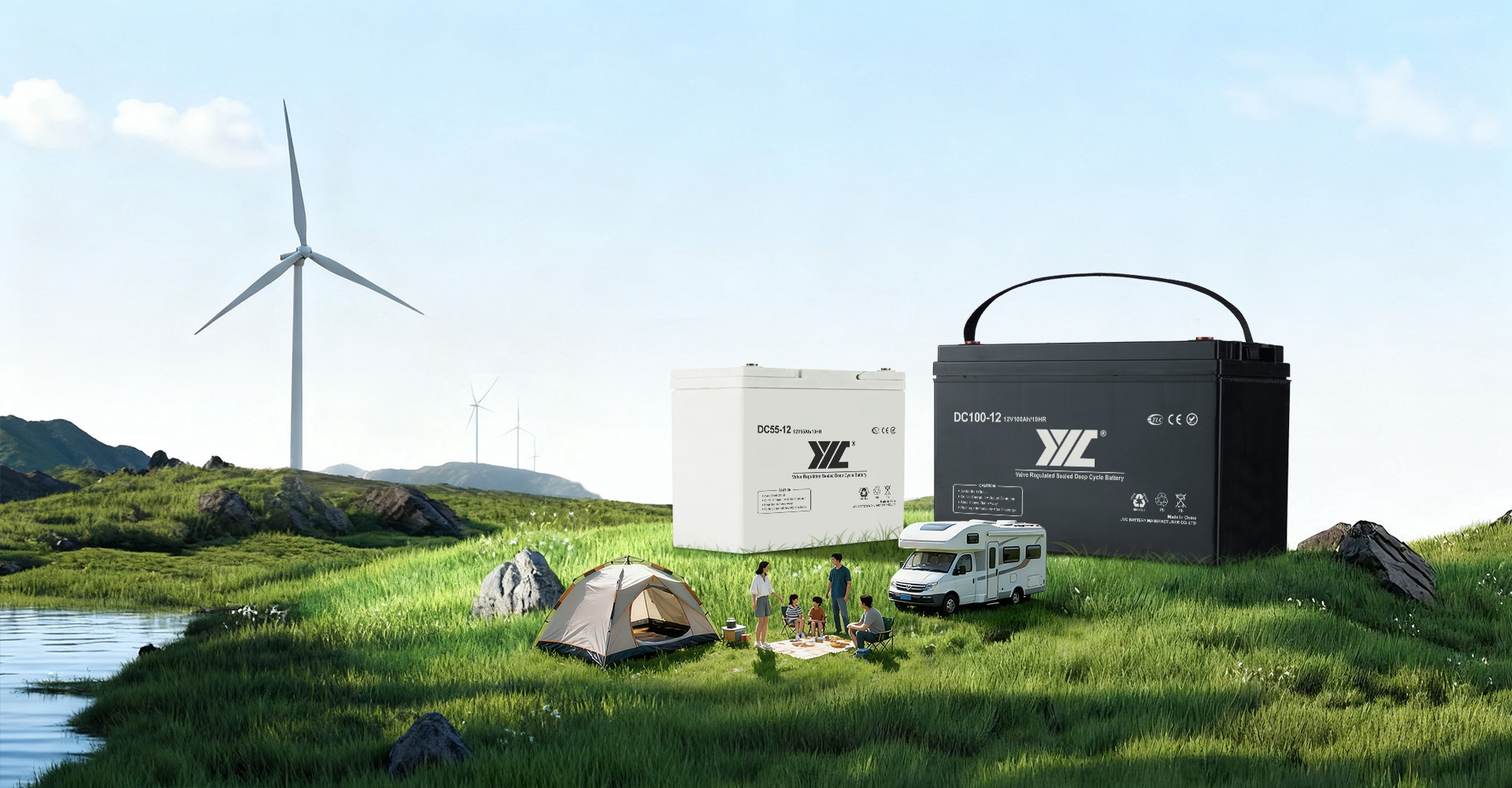
Our Industrial Batteries combine high-quality materials, robust design, and dependable performance. With excellent deep-cycle capability and easy maintenance, they are ideal for diverse applications. ...
JYC Transportation batteries are a category of power storage devices specifically designed for transportation scenarios, with core functions of providing continuous, stable, and high-efficiency power ...
JYC Motive Power batteries are deep-cycle energy storage devices specifically designed for industrial and commercial vehicles and specialized equipment. Their core function is to provide continuous an...
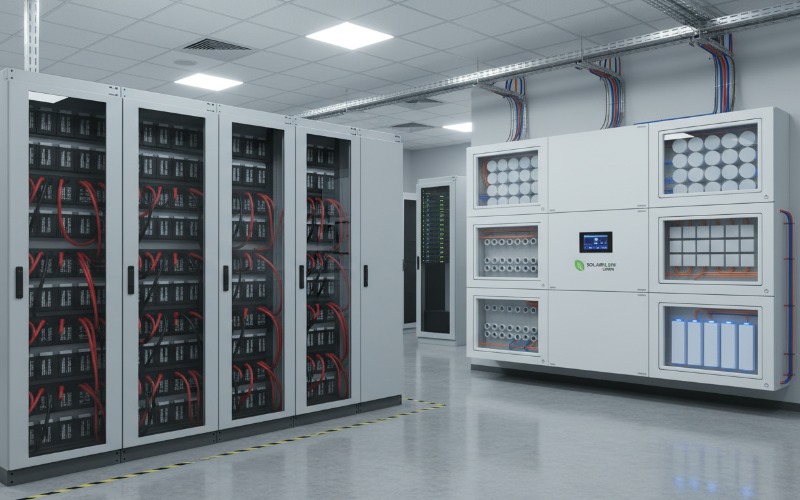
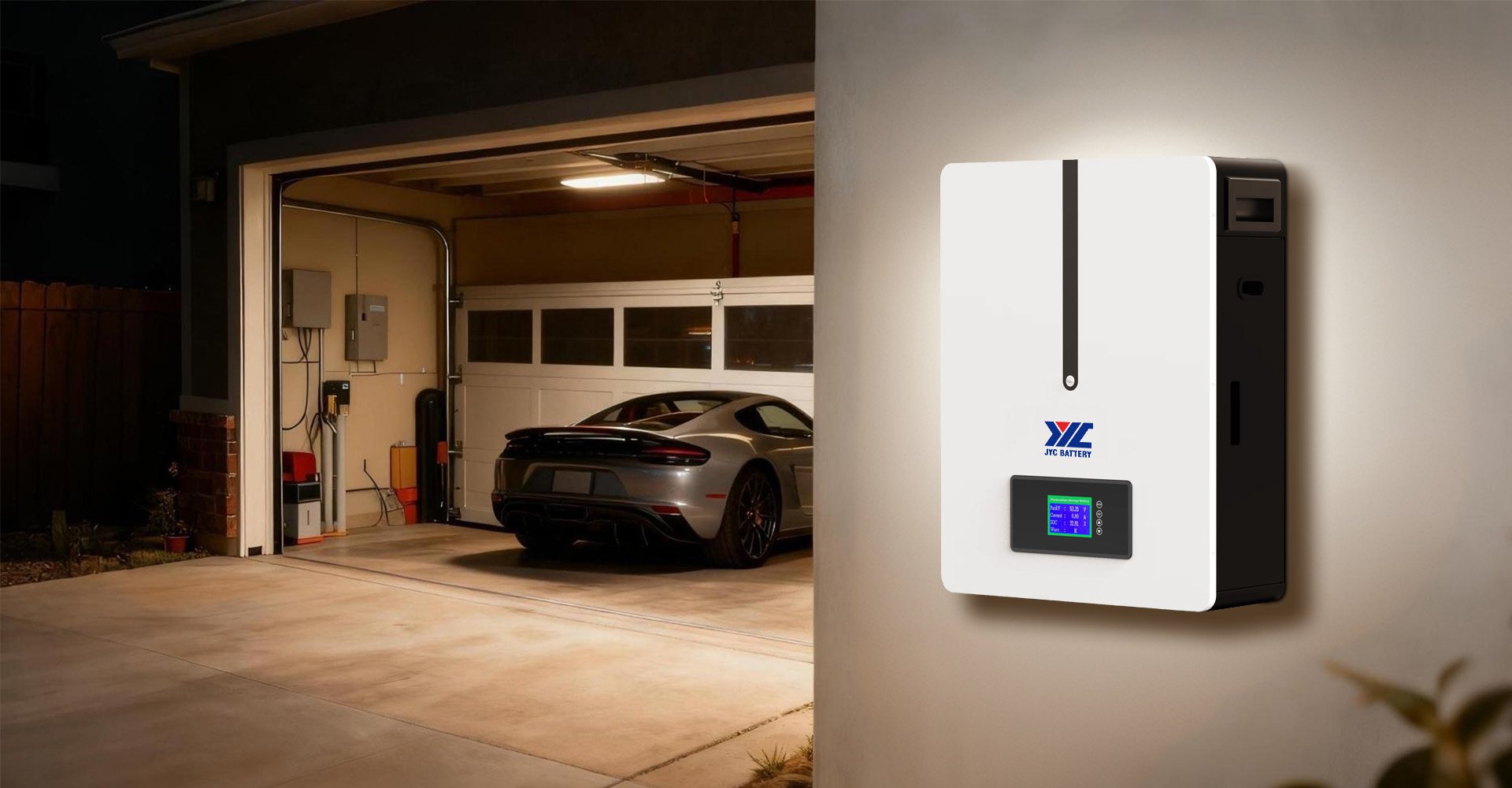
Based on the low-carbon concept, and thanks to the competitiveness of energy storage technology, lithium applications in various systems will be gradually realized globally. JYC Lithium Battery Soluti...
Focus on company news, product updates and market events. We provide continuous updates to bring you first-hand information, helping you stay informed about our development progress at all times.
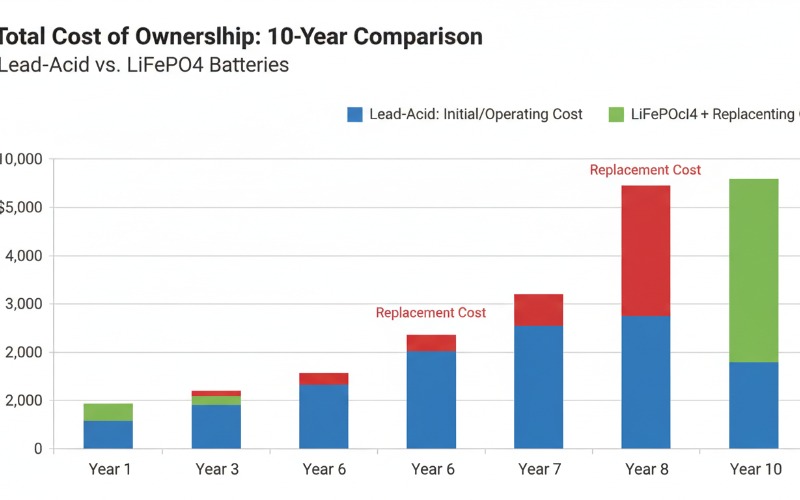
CapEx vs. OpEx Dynamic: Lead-Acid offers 50-60% lower initial CapEx, while LiFePO4 reduces long-term OpEx by up to 70% through efficiency and reduced maintenance.
Cycle Life Impact: LiFePO4 delivers 10x the cycle life at 80% Depth of Discharge (DOD) compared to standard AGM batteries, drastically lowering Levelized Cost of Energy (LCOE).
Application Specificity: Lead-Acid remains the ROI winner for infrequent standby applications (UPS), whereas LiFePO4 dominates cyclic applications like Telecom and Solar Storage.
Hidden Costs: TCO models must account for HVAC cooling costs, floor space, and replacement labor, where Lithium technology provides significant indirect savings.
For decades, the procurement strategy for industrial energy storage was relatively linear: minimize upfront expenditure. However, the maturation of Lithium Iron Phosphate (LiFePO4) technology has shifted the financial paradigm from Capital Expenditure (CapEx) to Total Cost of Ownership (TCO). For CFOs and project managers, the decision between staying with proven Lead-Acid technology or migrating to Lithium is no longer just technical—it is fundamentally financial.
This analysis provides a granular breakdown of the economic realities facing B2B buyers today. We move beyond simple datasheet comparisons to analyze the actual Levelized Cost of Storage (LCOS) across different industrial scenarios.
Defining the TCO Formula for Energy Storage
To accurately compare Lead-Acid and LiFePO4, we must define the TCO variables. A generic price-per-kWh comparison is misleading because it ignores the electrochemical degradation rates and operational overheads.
Lead-Acid batteries (AGM/GEL) typically cost 2-3 times less per kWh upfront than equivalent LiFePO4 systems. For projects with strict initial budget constraints or short operational horizons (under 3 years), this CapEx advantage is often the deciding factor.
2. Usable Capacity & Depth of Discharge (DOD)
This is the first hidden financial multiplier. A 100Ah Lead-Acid battery is typically limited to 50% DOD to preserve lifespan. In contrast, a 100Ah LiFePO4 battery can safely discharge 90-100%.
Financial Implication: To get 10kWh of usable energy, you need to purchase ~20kWh of Lead-Acid capacity but only ~11kWh of LiFePO4 capacity. This "oversizing factor" narrows the initial CapEx gap significantly.
Scenario Analysis: When to Stick with Lead-Acid
Despite the lithium hype, Lead-Acid remains the superior economic choice for specific profiles. The key variable is cycling frequency.
The Standby UPS Use Case
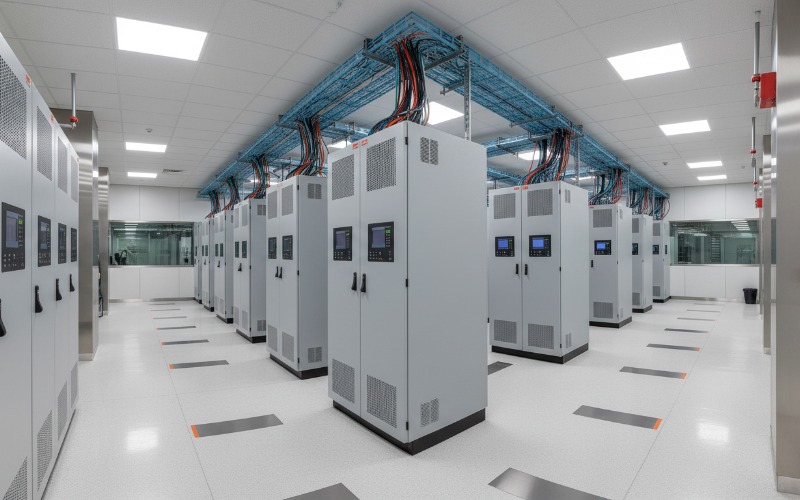
In Data Center UPS applications where grid reliability is high (99.9%), batteries sit in float charge mode for months or years. They may only discharge fully once or twice a year.
Cycle Requirement: Low (<50 cycles lifetime).
Shelf Life Focus: High importance on float life (10-12 years for high-quality AGM).
TCO Verdict:Lead-Acid Wins. The high cycle life of Lithium is wasted capital in an application that never cycles. The premium for LiFePO4 cannot be recouped through operational savings in a pure standby scenario.
Scenario Analysis: When to Switch to LiFePO4
The ROI for LiFePO4 becomes undeniable in cyclic applications, such as off-grid solar storage, peak shaving, and telecom base stations in regions with unstable grids.
The Daily Cycling Use Case
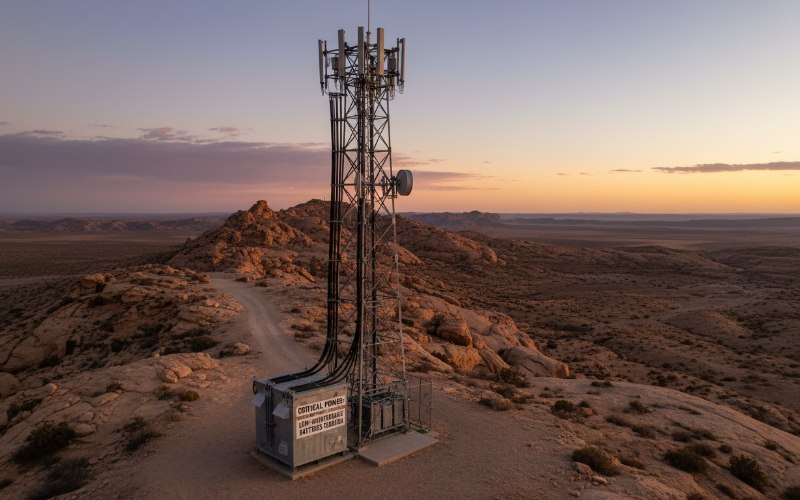
Consider a telecom tower that runs on battery power for 4 hours every night.
Cycle Requirement: 365 cycles per year.
Lead-Acid Performance: At 50% DOD, a standard AGM battery offers ~500-600 cycles. It will require replacement every 1.5 to 2 years.
LiFePO4 Performance: At 80% DOD, JYC's LiFePO4 cells offer 4000+ cycles. The battery will last 10+ years.
TCO Verdict:LiFePO4 Wins. Over a 10-year period, the Lead-Acid bank must be replaced 5 times. The cumulative cost of replacement hardware, logistics, and technician labor far exceeds the initial Lithium investment.
Detailed Financial & Technical Comparison Table
Metric
VRLA Lead-Acid (AGM)
LiFePO4 (Lithium Iron Phosphate)
Financial Impact
Initial Cost ($/kWh)
Low ($100 - $150)
High ($250 - $400)
Lead-Acid has lower barrier to entry.
Cycle Life @ 80% DOD
300 - 500 Cycles
4000 - 6000 Cycles
LiFePO4 lasts 10x longer in cyclic use.
Round-Trip Efficiency
80% - 85%
96% - 99%
LiFePO4 wastes less electricity (OpEx savings).
Weight / Energy Density
30-40 Wh/kg
100-130 Wh/kg
LiFePO4 reduces shipping and structural load costs.
Maintenance
Periodic checks required
Maintenance-Free (BMS managed)
LiFePO4 reduces labor OpEx.
Peukert Effect
High (Capacity drops under load)
Negligible
LiFePO4 maintains capacity at high discharge rates.
The Hidden OpEx: Energy Efficiency and Cooling
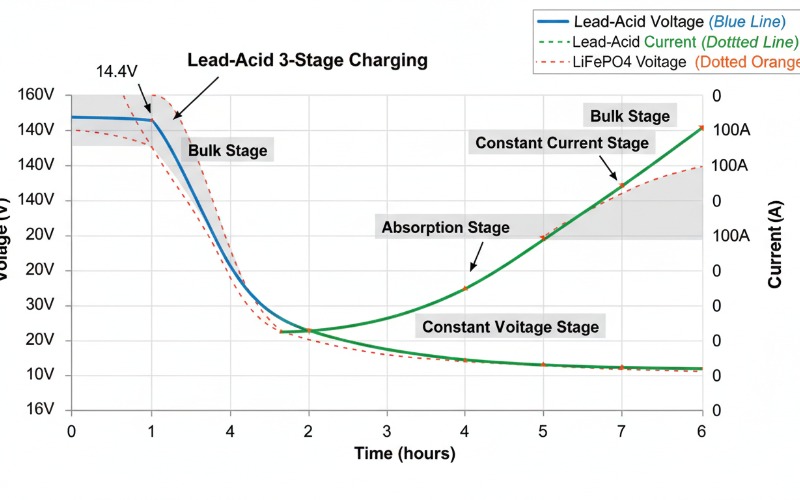
Often overlooked in TCO spreadsheets is the Round-Trip Efficiency (RTE). Lead-Acid batteries have an RTE of roughly 85%, meaning 15% of the energy put into the battery during charging is lost as heat. LiFePO4 maintains an efficiency of 98%.
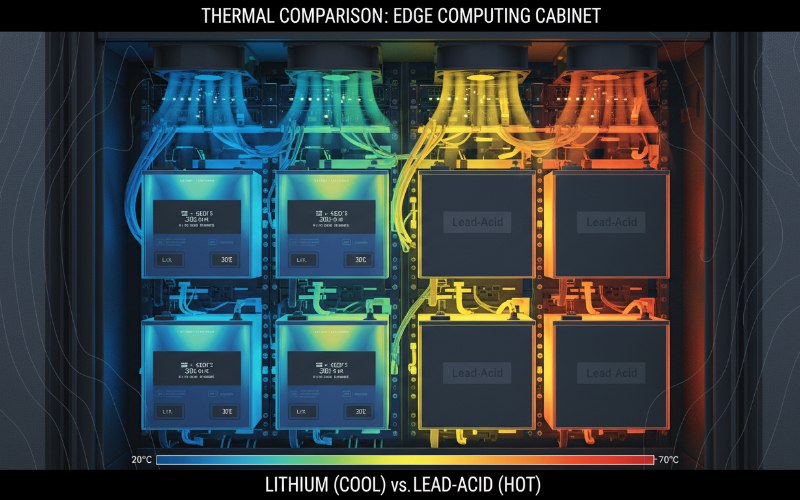
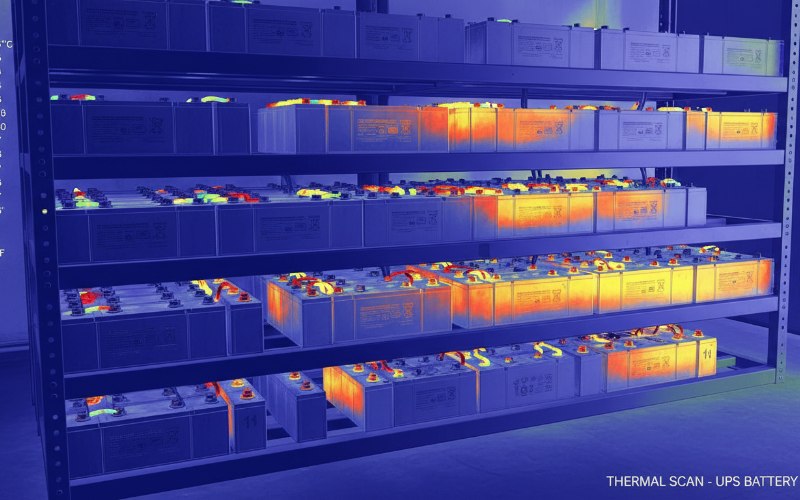
Cooling Costs: Because Lead-Acid batteries degrade rapidly above 25°C (77°F), they require strict climate control. For every 10°C increase above optimal, Lead-Acid life is cut in half. LiFePO4 is more temperature resilient, often tolerating up to 45°C without significant immediate degradation. This allows facility managers to reduce HVAC load, lowering electricity bills significantly over 10 years.
Peukert’s Law and Capacity Utilization
For engineers designing high-load systems, Peukert’s Law is critical. It dictates that as the rate of discharge increases, the available capacity of a lead-acid battery decreases. If you discharge a Lead-Acid battery in 1 hour (1C), you may only get 50-60% of its rated capacity.
LiFePO4 is not subject to significant Peukert losses. A 100Ah Lithium battery will deliver close to 100Ah whether discharged in 10 hours or 1 hour. For applications requiring high power surges, LiFePO4 allows for a smaller total bank size, further improving the TCO.
Final Decision Matrix for B2B Buyers
When finalizing your procurement strategy with JYC Battery, use this simplified matrix to guide your technology selection:
Choose Lead-Acid (AGM/GEL) If:
The application is standby/backup (UPS, Security Systems).
The environment is temperature-controlled.
Upfront budget is severely limited.
Installation is temporary ( < 3 years).
Choose LiFePO4 If:
The application involves daily cycling (Solar, Telecom, Peak Shaving).
Weight and space are constrained.
Access for maintenance is difficult or costly (Remote sites).
You intend to operate the system for 5+ years.
Frequently Asked Questions
Can I replace my existing Lead-Acid batteries with LiFePO4 directly?
In many cases, yes. JYC offers "Drop-in" LiFePO4 solutions with standard casing sizes. However, you must verify that your charger or rectifier settings are compatible with Lithium charging profiles (specifically voltage cut-offs) to prevent BMS shutdowns.
Does LiFePO4 pose a higher fire risk than Lead-Acid?
LiFePO4 (Lithium Iron Phosphate) is the safest lithium chemistry available. Unlike Cobalt-based lithium batteries (NMC/LCO), LiFePO4 has a very stable chemical structure and is highly resistant to thermal runaway. While Lead-Acid is non-flammable (aqueous electrolyte), modern LiFePO4 is considered safe for industrial use when paired with a quality Battery Management System (BMS).
What is the ROI timeframe for switching to Lithium?
For daily cyclic applications, the ROI break-even point typically occurs between years 3 and 4. After this point, the LiFePO4 system is effectively "free" compared to the Lead-Acid alternative, which would require replacement and continued maintenance.






 en
en  ara
ara  de
de  fra
fra  kor
kor  ru
ru  spa
spa  vie
vie