This is more than just a series of products; it is an ecosystem we have built to achieve a more efficient, reliable, and sustainable energy future. Discover how our products and solutions can create t...
Our Industrial Batteries combine high-quality materials, robust design, and dependable performance. With excellent deep-cycle capability and easy maintenance, they are ideal for diverse applications. ...
JYC Transportation batteries are a category of power storage devices specifically designed for transportation scenarios, with core functions of providing continuous, stable, and high-efficiency power ...
JYC Motive Power batteries are deep-cycle energy storage devices specifically designed for industrial and commercial vehicles and specialized equipment. Their core function is to provide continuous an...
Focus on company news, product updates and market events. We provide continuous updates to bring you first-hand information, helping you stay informed about our development progress at all times.
A deep cycle lead battery is an electrochemical energy storage device designed to provide sustained power over extended durations by tolerating repeated deep discharges. Unlike starting batteries, these units utilize thick lead plates and high-density active materials to maintain structural integrity during 80% Depth of Discharge (DoD) cycles. This engineering focus prioritizes long-term energy delivery over short-duration high-cranking current.
Key Takeaways for Engineers
Deep cycle batteries are designed for 500 to 3,000 discharge cycles depending on the specific grid alloy and maintenance protocols.
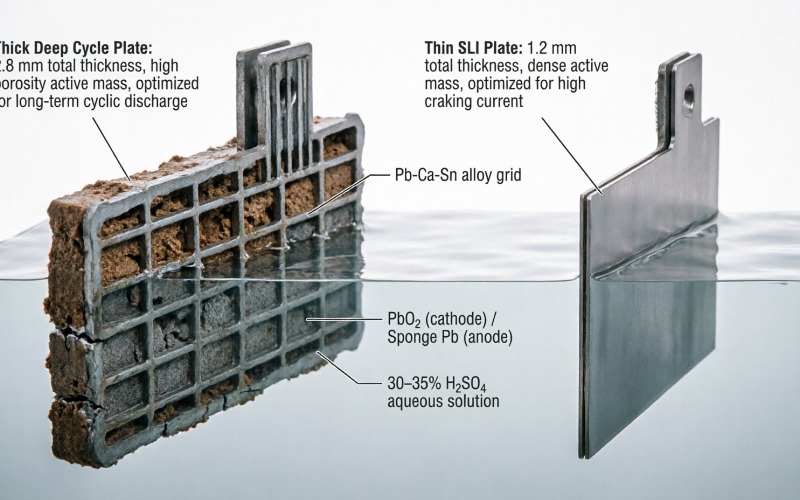
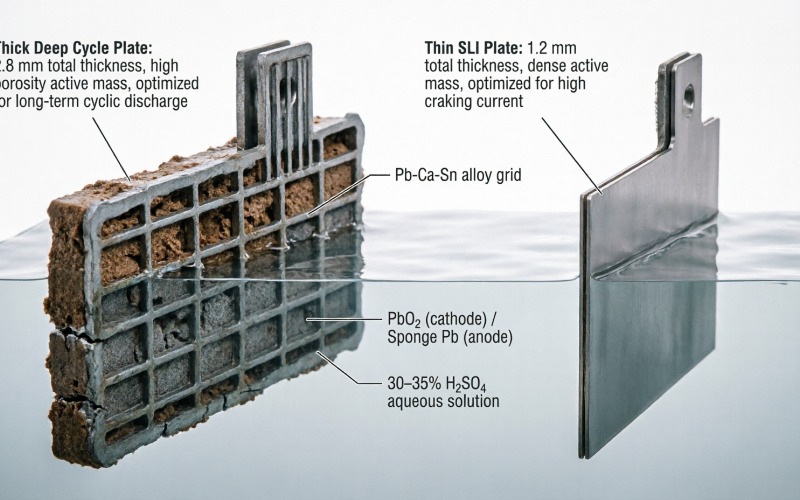
The primary structural difference lies in the plate thickness, which is significantly greater than that of Starting, Lighting, and Ignition (SLI) batteries.
According to the Battery Council International (BCI), maintaining a consistent Depth of Discharge (DoD) below 50% can double the expected service life.
Thermal management is critical, as internal resistance increases by approximately 10% for every 10-degree Celsius drop below 25°C.
How does the internal architecture of a deep cycle battery differ from SLI?
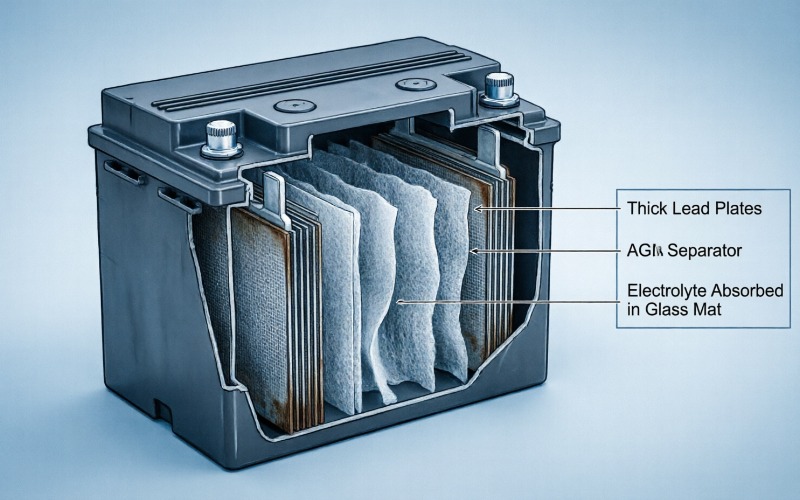
The engineering philosophy of a deep cycle lead battery centers on the physical robustness of the positive and negative plates. In a standard starting battery, the plates are thin and numerous, maximizing surface area to facilitate the high-current bursts required for engine ignition. Conversely, deep cycle plates are thick, solid lead grids coated with a high-density lead-oxide paste. According to IEEE standards for stationary batteries, this thickness allows the battery to withstand the mechanical stresses of repeated chemical conversion without shedding active material.
Research from the National Renewable Energy Laboratory (NREL) indicates that deep cycle batteries typically feature plates that are 25% to 40% thicker than those in SLI batteries. This structural mass is essential because the chemical process of discharging converts lead dioxide (PbO2) into lead sulfate (PbSO4), which occupies more volume. Thicker plates provide the necessary reinforcement to prevent warping or cracking during these volumetric changes. In industrial applications, the specific gravity of the electrolyte is often adjusted to 1.280 to optimize ion transport during long-duration discharges.
For a suitable configuration, review our lithium battery solutions for specifications and deployment options.
What are the chemical mechanisms during a deep discharge cycle?
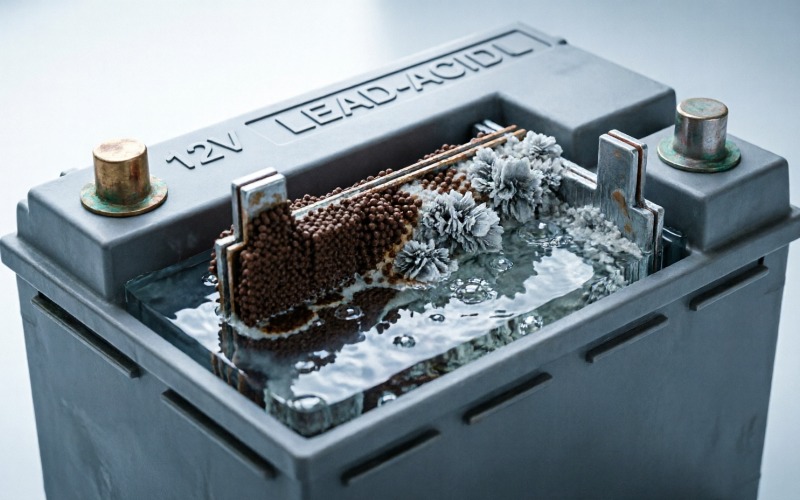
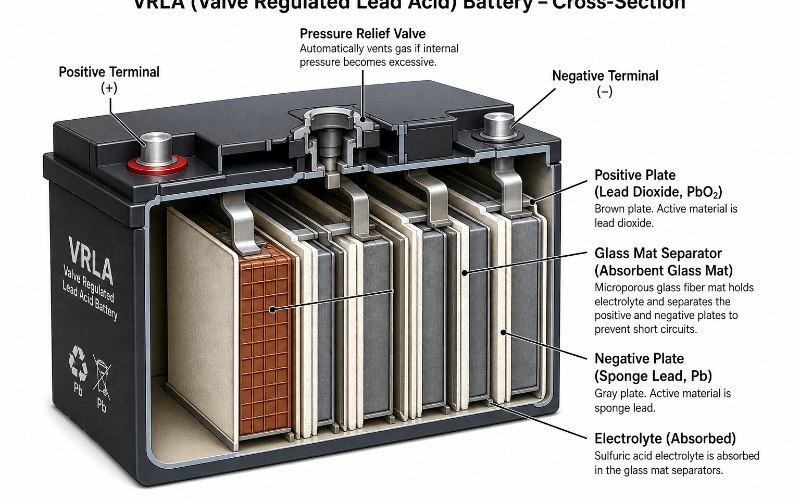
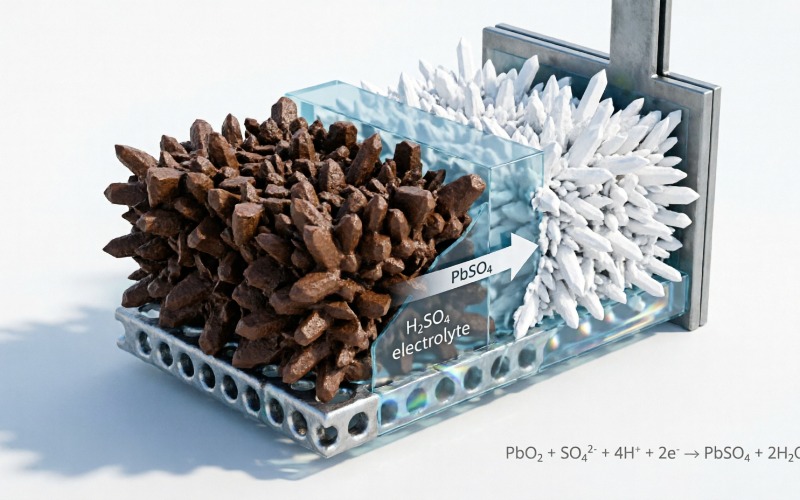
The operation of a deep cycle lead battery relies on the double sulfate chemical reaction. During discharge, both the lead dioxide at the positive plate and the sponge lead at the negative plate react with the sulfuric acid (H2SO4) in the electrolyte. This reaction produces lead sulfate and water (H2O). According to the U.S. Department of Energy, the concentration of the acid decreases as the battery discharges, lowering the voltage potential. In deep cycle applications, the battery is engineered to continue this reaction until most of the active material is converted, without damaging the grid structure.
A critical challenge in this process is sulfation, where lead sulfate crystals harden on the plates. If the battery remains in a discharged state, these crystals become difficult to reconvert during the charging phase. Data from Battery University shows that approximately 85% of lead-acid battery failures are attributed to irreversible sulfation caused by chronic undercharging. To mitigate this, junior engineers must ensure that charging profiles include a proper absorption stage to fully convert lead sulfate back into lead dioxide and sponge lead, restoring the electrolyte's specific gravity.
How do you calculate discharge performance using Peukert’s Law?
For electrical engineers, understanding the relationship between discharge rate and capacity is fundamental. Peukert's Law explains that as the rate of discharge increases, the available capacity of a lead-acid battery decreases. The formula is expressed as t = H(C/IH)^k, where 'k' is the Peukert constant. For a typical deep cycle lead battery, the Peukert constant ranges from 1.1 to 1.3. According to a 2024 study published in the Journal of Power Sources, a battery rated at 100Ah at a 20-hour rate might only provide 60Ah if discharged in just one hour.
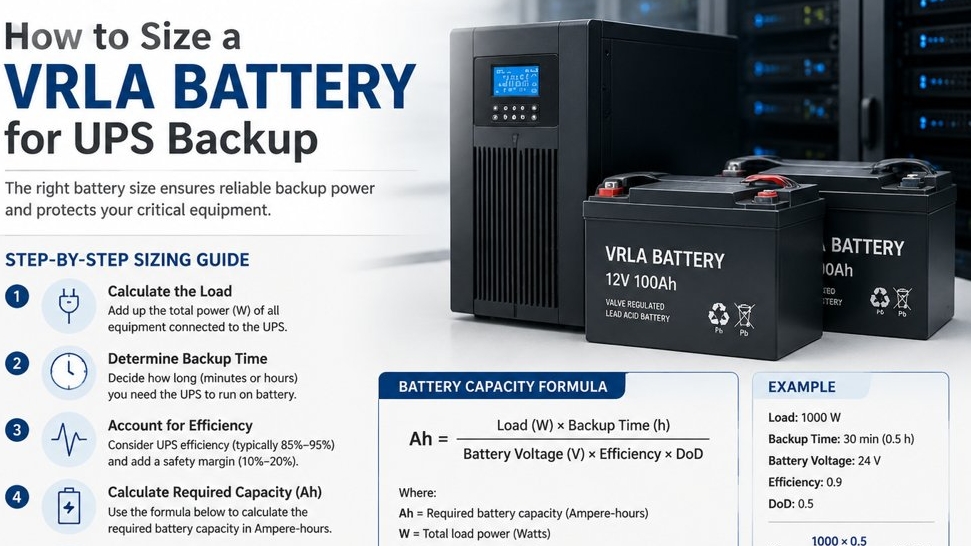
This phenomenon occurs because high-current discharges lead to a rapid depletion of ions in the electrolyte immediately surrounding the plates. The diffusion of ions from the bulk electrolyte cannot keep pace with the reaction rate. Consequently, the internal resistance rises, and the terminal voltage drops prematurely. Engineers designing UPS systems or solar arrays must account for this by oversizing the battery bank by at least 20% to ensure the required runtime is met under high-load conditions. Accurate modeling of these variables is essential for system reliability and cost optimization.
How do temperature variations impact lead-acid battery lifespan?
Temperature is perhaps the most influential environmental factor affecting the performance of a deep cycle lead battery. While higher temperatures initially increase capacity by accelerating chemical reactions, they simultaneously accelerate internal corrosion and electrolyte evaporation. According to the International Electrotechnical Commission (IEC), every 8-degree Celsius increase above the standard operating temperature of 25°C halves the battery's service life. This is a critical consideration for engineers deploying batteries in tropical climates or uncooled server rooms.
Conversely, cold temperatures increase internal resistance and decrease available capacity. At 0°C, a lead-acid battery may lose up to 30% of its rated capacity compared to its performance at 25°C. Research from the Society of Automotive Engineers (SAE) highlights that charging voltages must be temperature-compensated to prevent overcharging in heat and undercharging in cold. Modern industrial chargers use thermal sensors to adjust the voltage by -3mV to -5mV per cell for every degree Celsius rise, ensuring the battery remains within its optimal electrochemical window.
Expert Insight on Grid Technology
"Deep cycle technology represents the backbone of renewable energy stability, where the physical thickness of the grid determines the electrochemical lifespan. Innovations in lead-calcium-tin alloys are now pushing the boundaries of corrosion resistance in high-temperature environments."
Which industrial sectors rely on deep cycle technology?
Deep cycle lead batteries are indispensable in sectors where reliability and cost-per-cycle are paramount. In the renewable energy sector, they serve as the primary storage medium for off-grid solar systems. According to the International Renewable Energy Agency (IRENA), lead-acid batteries still account for over 40% of small-scale solar storage installations globally due to their recyclability and proven safety profile. Their ability to handle erratic charging patterns from solar PV makes them ideal for rural electrification projects.
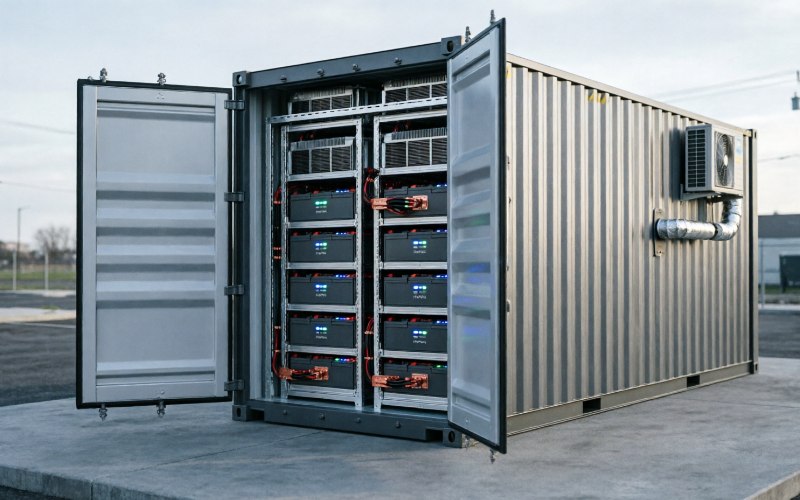
In the material handling industry, electric forklifts and automated guided vehicles (AGVs) utilize massive deep cycle battery banks to power 8-to-12-hour shifts. These batteries are designed for heavy-duty discharge, often reaching 80% DoD daily. Data from the Material Handling Institute (MHI) indicates that lead-acid systems remain the most cost-effective solution for large fleets, provided that proper maintenance and charging infrastructure are in place. Furthermore, the telecommunications industry utilizes Valve Regulated Lead-Acid (VRLA) deep cycle batteries for backup power in remote cell towers, ensuring 99.999% network uptime.
What are the essential maintenance protocols for engineers?
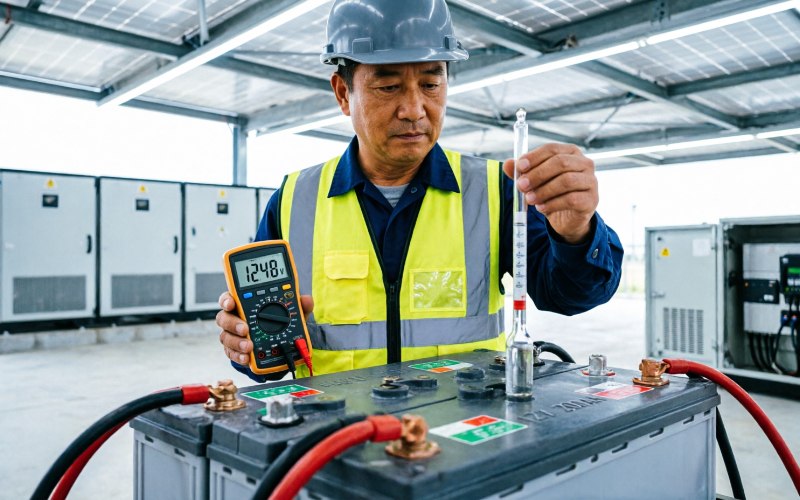
Maximizing the ROI of a deep cycle lead battery bank requires rigorous adherence to maintenance schedules. For flooded lead-acid (FLA) batteries, regular equalization charges are necessary to prevent electrolyte stratification, a condition where acid concentrates at the bottom of the cell. According to EUROBAT, equalization involves a controlled overcharge that produces gas bubbles, effectively mixing the electrolyte. This process should be performed every 30 days or when the specific gravity readings between cells vary by more than 0.030.
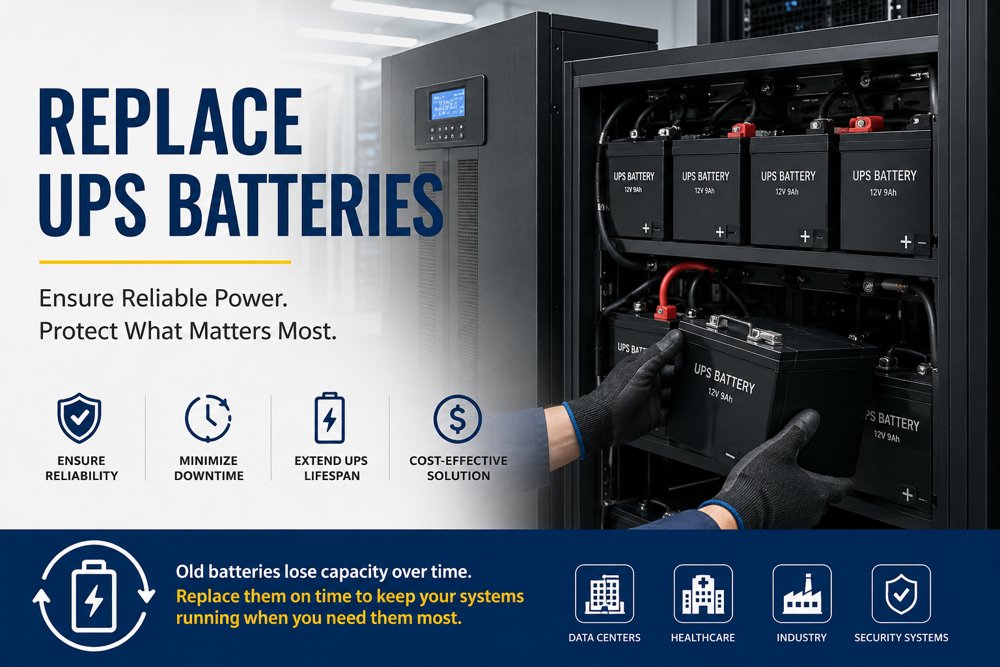
For VRLA batteries, such as AGM and Gel types, maintenance is more focused on thermal monitoring and terminal torque checks. Since these batteries are sealed, they cannot be watered, making them sensitive to overcharging which can cause "thermal runaway." Research indicates that 15% of VRLA failures in data centers are caused by loose terminal connections that create localized heat. Engineers should use infrared thermography during discharge tests to identify high-resistance points. Proper ventilation is also required to prevent the accumulation of hydrogen gas, even in maintenance-free models.
Frequently Asked Questions
Can I use a deep cycle battery to start my car?
Yes, but it is not recommended. While a deep cycle battery can provide the necessary current, it lacks the high Cold Cranking Amps (CCA) rating of a dedicated starting battery. According to BCI standards, using a deep cycle battery for frequent engine starts can lead to premature wear of the active material due to the high-intensity discharge spikes that it was not primarily designed to handle. For system planning, see our energy storage solutions to align the battery choice with site requirements.
How long does a deep cycle lead battery typically last?
The lifespan depends on the Depth of Discharge. Typically, a high-quality deep cycle battery will last 4 to 8 years in a backup application (UPS) or 500 to 1,000 cycles in a solar application where it is cycled daily. Maintaining the battery in a fully charged state and avoiding discharges below 50% are the most effective ways to extend its operational life beyond 2,000 days.
What is the difference between AGM and Flooded deep cycle batteries?
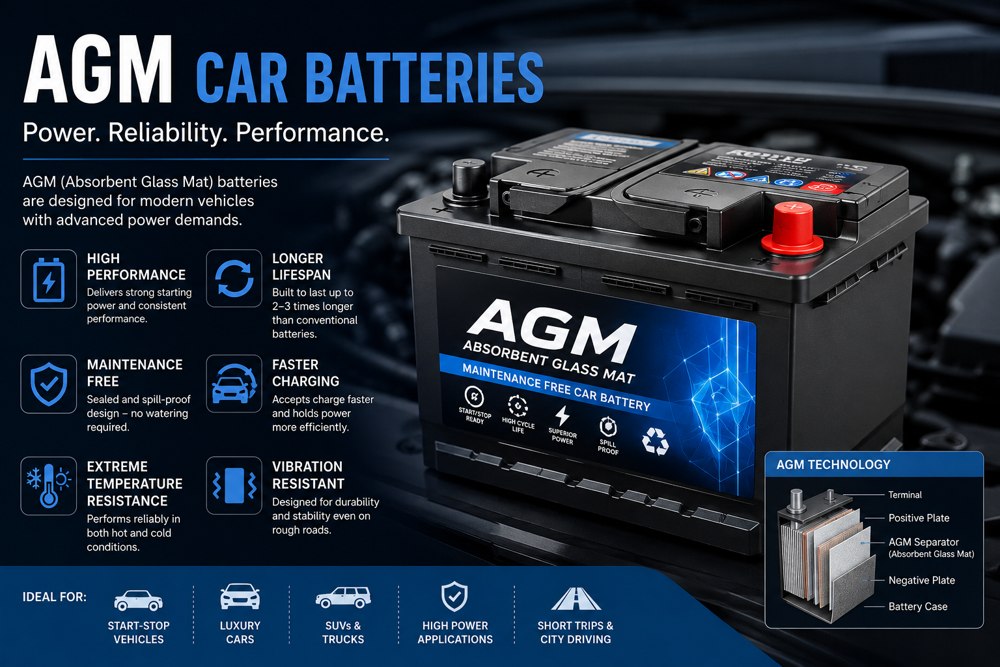
Absorbent Glass Mat (AGM) batteries use a fiberglass separator to immobilize the electrolyte, making them spill-proof and more resistant to vibration. Flooded batteries contain liquid acid and require periodic watering. Data shows that AGM batteries have a lower self-discharge rate (1-3% per month) compared to flooded batteries (5-10% per month), making them superior for seasonal use or remote installations.
How do I know if my deep cycle battery is bad?
A capacity test is the most accurate method. If a battery cannot maintain 80% of its rated capacity during a controlled discharge test, it is considered at the end of its useful life. Additionally, a significant drop in open-circuit voltage (below 10.5V for a 12V battery) under a moderate load often indicates a dead cell or severe sulfation that cannot be recovered.








 en
en  fra
fra  spa
spa  de
de  vie
vie  ru
ru  ara
ara  kor
kor