This is more than just a series of products; it is an ecosystem we have built to achieve a more efficient, reliable, and sustainable energy future. Discover how our products and solutions can create t...
Our Industrial Batteries combine high-quality materials, robust design, and dependable performance. With excellent deep-cycle capability and easy maintenance, they are ideal for diverse applications. ...
JYC Transportation batteries are a category of power storage devices specifically designed for transportation scenarios, with core functions of providing continuous, stable, and high-efficiency power ...
JYC Motive Power batteries are deep-cycle energy storage devices specifically designed for industrial and commercial vehicles and specialized equipment. Their core function is to provide continuous an...
Focus on company news, product updates and market events. We provide continuous updates to bring you first-hand information, helping you stay informed about our development progress at all times.
The Chemistry Behind Lead Acid Battery Sulfation and How to Identify Early Warning Signs
2026-11-20 18:25:13
Lead acid battery sulfation symptoms indicate the formation of lead sulfate crystals on negative plates, which progressively diminishes storage capacity. According to the International Electrotechnical Commission (IEC), unattended crystal hardening leads to permanent capacity loss in Valve-Regulated Lead-Acid (VRLA) systems. This troubleshooting guide explores the chemical origins, partial state-of-charge risks, and practical recovery limits for industrial backup power applications.
What causes lead sulfate crystals to form and harden on negative battery plates?
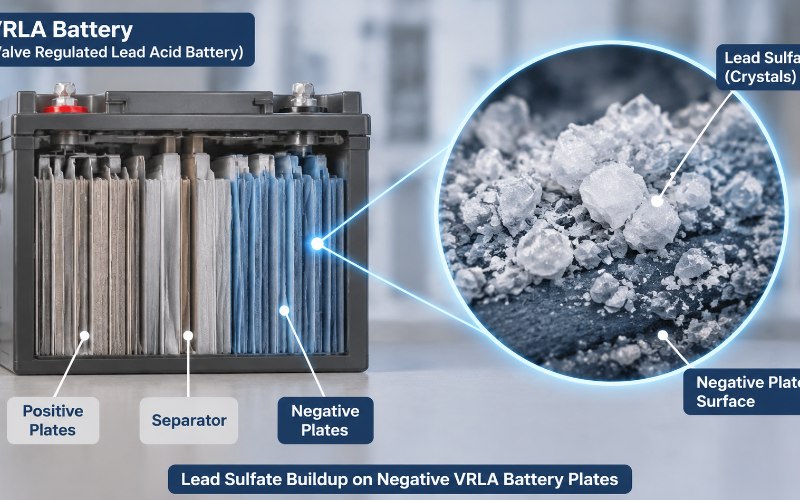
During normal discharge cycles, sponge lead (Pb) on the negative plates and lead dioxide (PbO_2) on the positive plates react with sulfuric acid (H_2SO_4) to produce lead sulfate (PbSO_4). This fundamental electrochemical process releases electrical energy to the connected load. However, when a battery remains uncharged for extended periods, these initial microcrystals undergo Ostwald ripening.
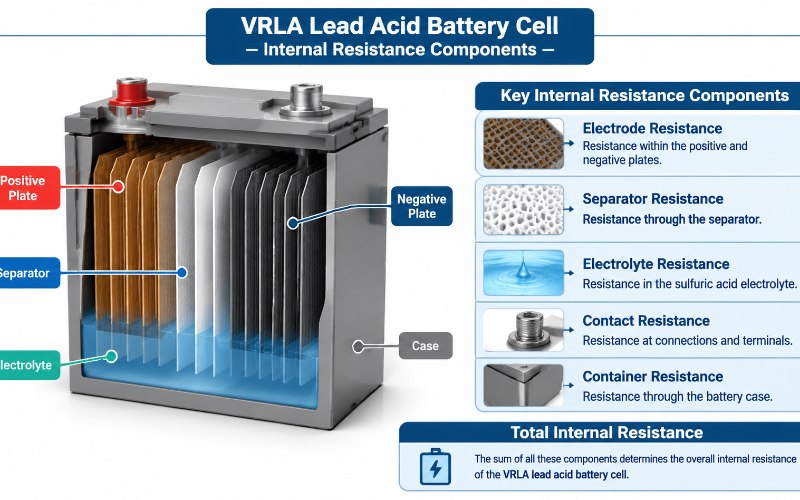
Ostwald ripening describes how smaller crystals dissolve and redeposit onto larger crystals over time. According to IEEE standards for stationary battery maintenance, this thermodynamic shift reduces the active surface area of the plate. Consequently, the internal resistance of the VRLA battery increases significantly, restricting current acceptance during subsequent recharge cycles.
Reversible fine microcrystalline sulfation versus permanent hard crystal accumulation
Differentiating between soft and hard sulfation is essential for effective maintenance planning. Soft sulfation consists of fine, porous lead sulfate crystals formed immediately after a standard discharge cycle. These amorphous structures dissolve readily back into lead and sulfuric acid during a properly managed constant-voltage recharge.
Conversely, permanent hard crystal accumulation occurs when lead sulfate remains on the plates for weeks or months. These large, stable crystals exhibit high electrical resistivity and block electrolyte penetration. According to electrochemical research, roughly 85% of premature VRLA battery failures stem from unaddressed hard crystallization that resists standard charging protocols.
Sulfation Type
Crystal Size
Reversibility
Internal Resistance Impact
Soft Microcrystalline
< 1 micrometer
Fully Reversible via Standard Charge
Minimal increase
Hard Crystalline
> 10 micrometers
Partially or Irreversible
Increases by 200% to 500%
Advanced Sulfation
Visible macroscopic aggregates
Irreversible
Severe open-circuit voltage failure
How prolonged operation at partial state of charge accelerates plate degradation
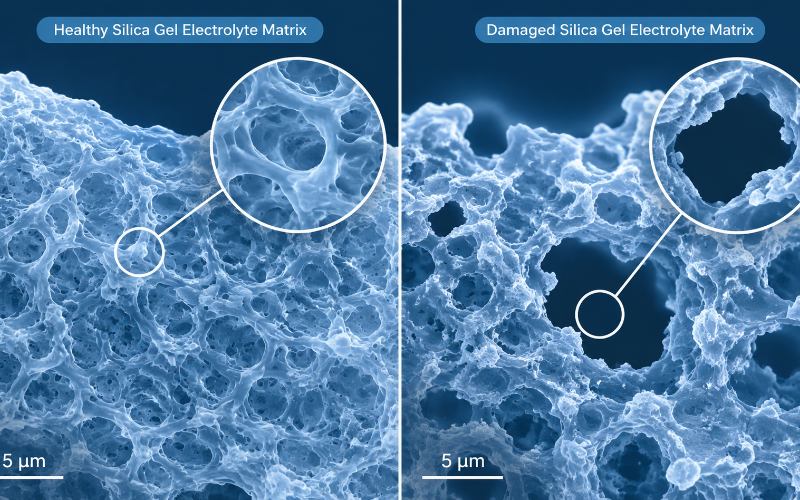
Operating backup batteries at a partial state of charge (PSoC) creates an aggressive environment for plate degradation. In telecommunications and renewable energy storage, frequent micro-cycling without a full 100% recharge leaves residual lead sulfate behind. Over 300 to 500 cycles, this unconverted material permanently alters the microscopic porosity of the negative active material.
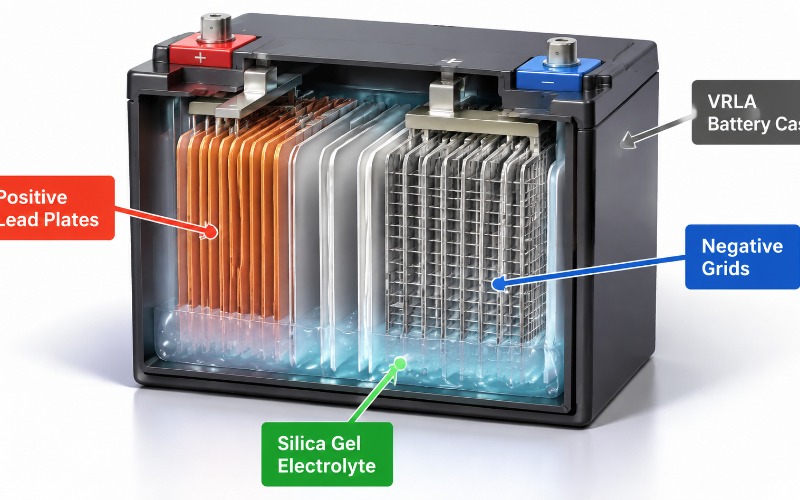
Data from stationary power research indicates that operating continuously below a 70% state of charge accelerates capacity loss by up to 40% annually. The localized acid stratification inside absorbent glass mat (AGM) or gel cells further exacerbates this imbalance, leaving lower plate regions permanently sulfated despite surface voltage readings appearing normal.
Observable electrical and thermal symptoms of a heavily sulfated VRLA battery string
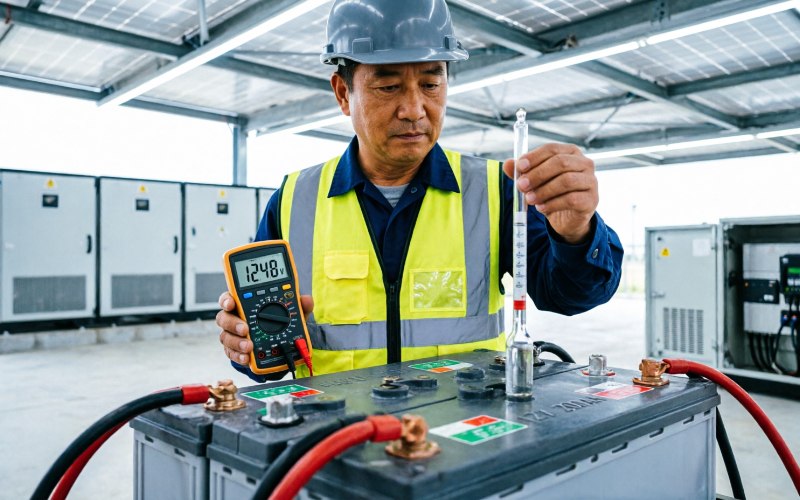
Identifying lead acid battery sulfation symptoms early prevents catastrophic system failures during emergency power outages. Technicians must monitor specific electrical and thermal indicators across the entire battery string. Elevated float charging currents combined with reduced discharge runtime serve as primary diagnostic red flags.
Key diagnostic warning signs include:
Rapid voltage drop immediately upon applying an electrical load test.
Excessive thermal generation during charging due to high internal ohmic resistance.
Failure of specific blocks to reach manufacturer-specified full-charge voltage thresholds.
Noticeable reduction in overall Ampere-hour (Ah) delivery during routine load capacity tests.
Can a sulfated lead acid battery be recovered through controlled pulse desulfation techniques?
Controlled pulse desulfation utilizes high-frequency current pulses to disrupt large lead sulfate crystal lattices through mechanical resonance. When tuned to the natural resonant frequency of lead sulfate—typically between 2 kHz and 10 kHz—these electrical pulses encourage crystals to dissolve back into the electrolyte solution.
However, recovery feasibility depends entirely on the age and degradation severity of the battery plates. Field studies show that pulse conditioning successfully restores 60% to 70% of lost capacity in moderately sulfated units under 24 months old. Severely deformed plates with physical grid corrosion or short-circuited separators cannot be recovered and require immediate replacement.






 en
 fra
 spa
 de
 vie
 ru
 ara
 kor