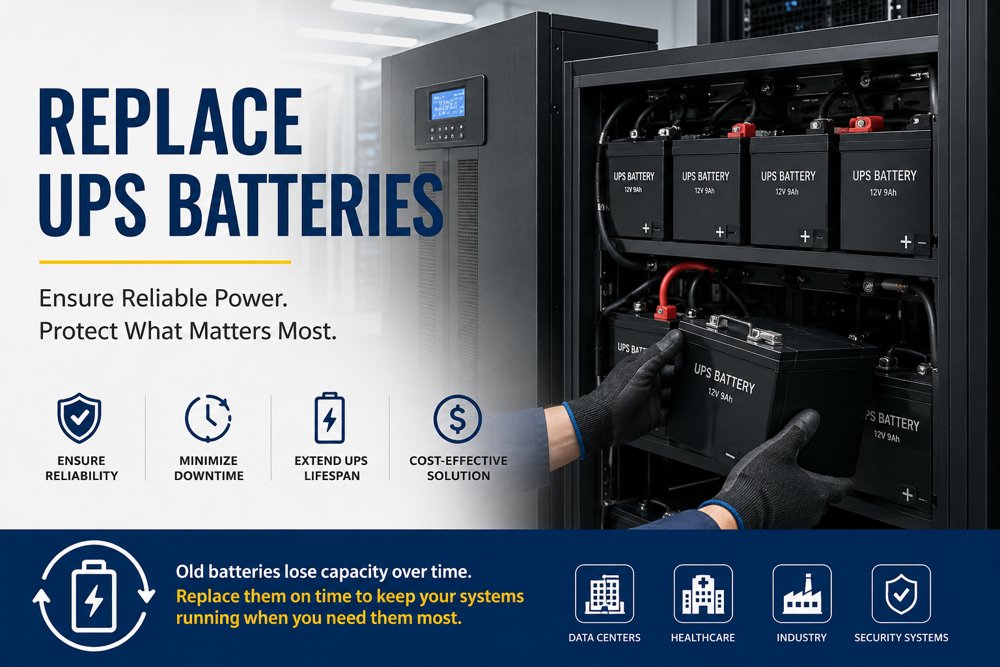
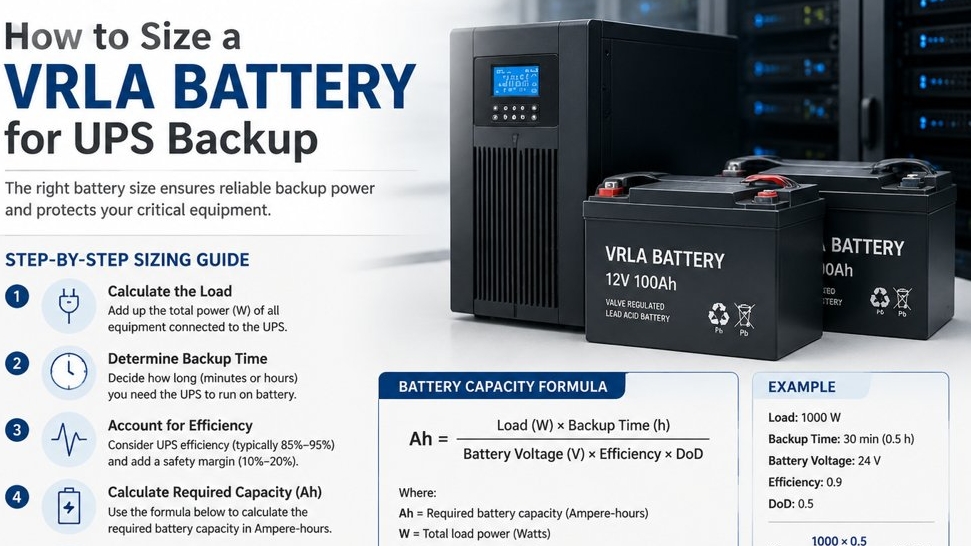
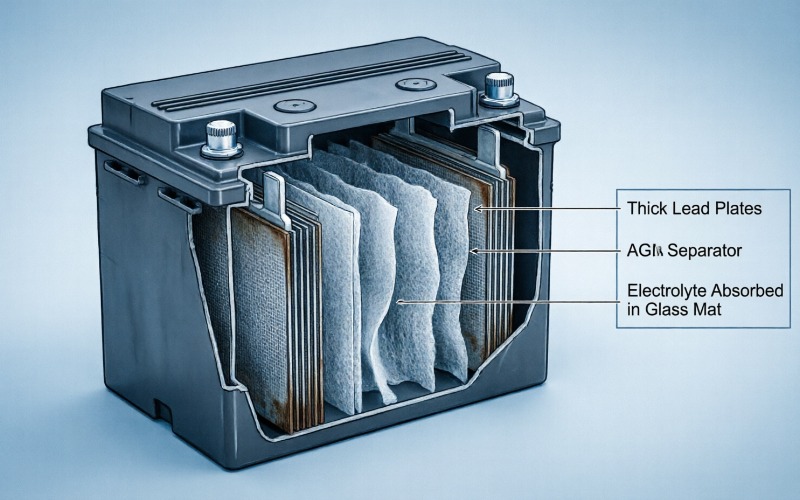
A VRLA battery bank for UPS backup should be sized from the UPS system voltage, actual protected load, required backup time, and the battery's published discharge data. Start with the UPS manufacturer's required DC configuration, then use the selected model's discharge table at the expected operating conditions. Confirm temperature, end-of-discharge voltage, aging policy, charger capability, rack space, terminals, and cable design before finalizing the quantity.
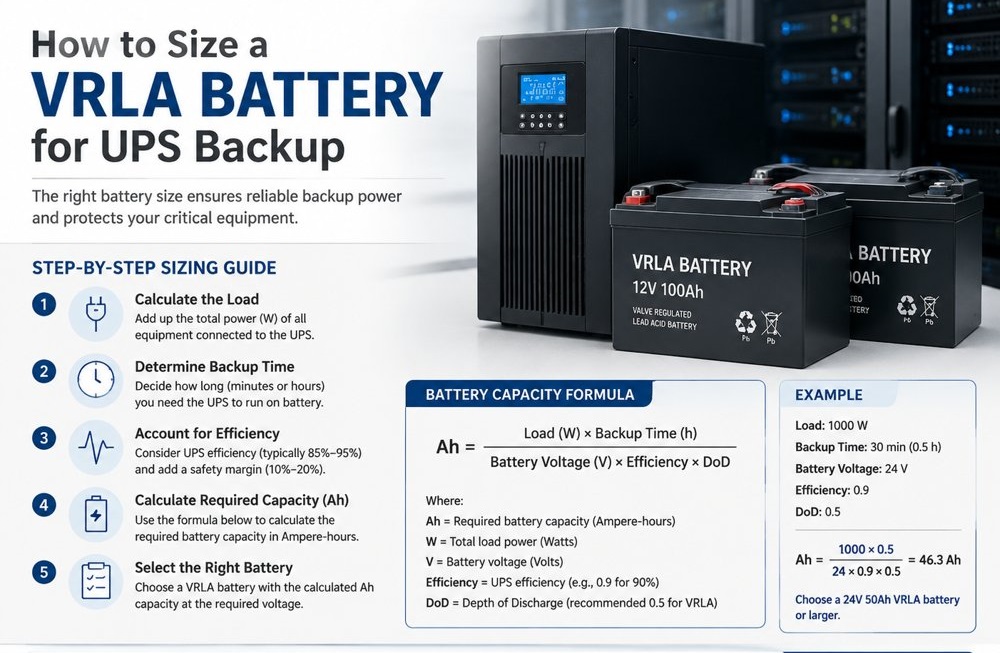
Amp-hour rating alone is not enough for UPS battery sizing. A battery can have a suitable nominal capacity at one discharge duration but not provide the required power at a shorter, higher-current discharge. For this reason, the final selection should be based on the exact discharge table for the selected VRLA model and verified against the UPS manufacturer's requirements.
For UPS applications, start with the JYC UPS battery solutions. For a broader introduction to battery construction and applications, see the VRLA battery.
What Information Is Needed to Size a UPS Battery Bank?
Collect the electrical and site information before comparing battery models. The most useful sizing inputs are:
| Sizing input | Why it matters | Where to confirm it |
|---|
| UPS model and nominal DC voltage | Defines the battery string configuration and permitted operating range | UPS nameplate, manual, or manufacturer documentation |
|---|
| Actual load in kW or W | Determines the power the battery bank must support | UPS monitoring system or verified load survey |
|---|
| Required backup time | Defines the discharge duration to use in battery tables | Site continuity plan or facility requirement |
|---|
| UPS efficiency and DC current | Affects the current drawn from the battery bank | UPS manufacturer data or engineering calculation |
|---|
| End-of-discharge voltage | Changes the usable discharge data and the number of blocks in the system | UPS manufacturer documentation |
|---|
| Ambient temperature range | Temperature can affect available capacity and battery condition | Site survey and temperature records |
|---|
| Future load growth and aging policy | Determines whether a design allowance is required | Project design brief or maintenance policy |
|---|
| Space, terminals, and cable layout | Confirms the proposed bank can be installed and connected correctly | Rack drawing, cabinet drawing, and site photos |
|---|
Use measured load data where available, and include planned load growth in the project brief.
For a suitable configuration, review our HR Series high-rate batteries for specifications and deployment options.
For additional lifecycle and operating context, see deep cycle batteries for UPS systems as a follow-up reference.
How Do Load and Runtime Determine the Required Battery Duty?
Record the protected load and required runtime, then use the UPS manufacturer's efficiency or published DC-current data to determine the expected battery discharge current.
A preliminary energy estimate can help compare options:
Required backup energy (Wh) = protected load (W) x backup time (h)
This is a screening estimate, not a final sizing method. Final selection should use the selected model's published constant-power, constant-current, or capacity data at the applicable duration, end voltage, and temperature condition.
Select by Published Discharge Data, Not Amp-Hour Rating Alone
Compare the required current or power against the battery manufacturer's published table at the required duration, end-of-discharge voltage, and temperature condition. Do not compare only the 20-hour capacity printed in a general product description.
Use the data format that matches the UPS manufacturer's sizing method. Include an approved battery list or sizing tool in the design review when available.
For short-duration UPS requirements, the JYC HR Series can be reviewed because its product information includes 15-minute power data. For general stationary backup requirements, compare the discharge data for the JYC GP-Stationary Series with the project's duty profile. Model selection should always be confirmed against the relevant data sheet and UPS requirements.
How Many Batteries Are Required in a UPS String?
The UPS DC system design determines the series count, not a capacity preference. For a system using 12 V battery blocks, confirm the required number of blocks in the UPS documentation. Do not change the series count merely to increase runtime, because that can move battery voltage outside the UPS design range.
Runtime is commonly increased with additional parallel strings of the same compatible model and configuration. Derive the string quantity from required discharge duty and one string's published performance, then check charger capability, protection, cable design, rack arrangement, and maintenance access.
Before approving a configuration, verify:
Battery block nominal voltage and UPS DC voltage range
Number of batteries in each series string
Number of parallel strings and individual string protection
Required runtime at the actual load
End-of-discharge voltage used for the table lookup
Charger output, recharge expectation, and battery manufacturer's charging guidance
Cable lengths, connection points, and terminal compatibility
Rack loading, footprint, ventilation, and service clearance
Use the UPS manufacturer's documented configuration as the starting point. A qualified engineer should review changes to string quantity, protection, or charger settings.
Temperature, Aging, and Installation Conditions Change the Result
Published discharge tables use stated test conditions. Size the bank using the battery manufacturer's temperature guidance and the expected site temperature, rather than assuming the room will always match data-sheet conditions.
Document any allowance for aging, load growth, or site reliability policy in the design brief. The appropriate allowance is project-specific.
Also verify rack dimensions, terminal orientation, cable routing, service clearance, safe replacement procedures, and applicable floor-loading or restraint requirements.
Compare Common UPS Battery Configurations Before You Purchase
| Configuration approach | When it may be considered | Key checks before approval |
|---|
| One string of higher-capacity batteries | When one compatible string can meet the duty and fit the site | Discharge data, rack loading, terminal/cable design, charger compatibility, and service access |
|---|
| Multiple parallel strings | When one string cannot meet the required runtime or site availability approach calls for more than one string | String balancing, individual protection, equal cable paths where applicable, charger capacity, and maintenance plan |
|---|
| Front-terminal VRLA layout | When cabinet depth and front-access maintenance are priorities | Exact model dimensions, terminal access, rack layout, and project discharge duty |
|---|
| High-rate VRLA selection | When the published data matches short-duration, high-current UPS duty | Required duration, end voltage, temperature condition, and UPS manufacturer compatibility |
|---|
For front-access rack layouts, review the JYC FT Series. For telecom and power installations, see the JYC telecom and power solutions. Final quantity still requires a model-specific discharge and installation review.
For a related technical reference, read our when UPS batteries should be replaced before finalizing the design.
A Practical VRLA UPS Battery Sizing Workflow
Confirm the backup objective. Define whether the battery bank must bridge generator start, support a controlled shutdown, or provide a longer outage period.
Record the UPS system details. Include UPS make and model, nominal DC voltage, allowed voltage range, charger data, and existing battery configuration.
Measure or validate the load. Record present load, power factor where relevant, expected load growth, and required runtime.
Select candidate battery models. Use published discharge tables at the correct duration, end voltage, and temperature condition.
Determine the string configuration. Follow the UPS-required series count and calculate the number of parallel strings required for the duty.
Check installation constraints. Confirm dimensions, terminal layout, cables, protection, rack loading, ventilation, delivery access, and maintenance clearance.
Review charging and commissioning. Confirm charger compatibility, initial inspection steps, and the test records required after installation.
This workflow creates a clearer RFQ and identifies compatibility questions before shipment or installation.
Request a VRLA UPS Battery Sizing Review
Send the JYC team your UPS make and model, system DC voltage, protected load, required backup time, existing battery model and quantity, site photos, rack dimensions, ambient temperature range, destination country, and required standards.
Request a VRLA UPS Battery Sizing Review
The review can help prepare a more complete RFQ. Final engineering approval should use the UPS manufacturer's requirements and selected battery model's technical documentation.
Frequently Asked Questions
Can I size a UPS battery bank only from amp-hour rating?
No. Amp-hour rating alone does not show how a battery will perform at every UPS discharge duration. Use the selected battery model's published discharge data at the required current or power, duration, end-of-discharge voltage, and applicable temperature condition.
How do I calculate the number of 12 V batteries for a UPS?
First confirm the required series count from the UPS manufacturer's DC system documentation. That determines the number of 12 V blocks in one string. Then use the required runtime and the selected battery's discharge data to determine whether additional parallel strings are needed.
Should I add a margin when sizing VRLA batteries for UPS backup?
A project may include an allowance for aging, future load growth, temperature conditions, or site reliability policy. The appropriate allowance depends on the application, maintenance plan, and manufacturer's guidance, so it should be documented and reviewed as part of the project design.
Can different VRLA battery models be used in the same UPS string?
Mixing battery models, capacities, ages, or condition levels in one string can make charging and discharge behavior less uniform. Use a compatible, consistent configuration unless a qualified engineer and the relevant equipment documentation support a different approach.
What should I send for a UPS battery sizing quotation?
Send the UPS model, nominal DC voltage, load, required runtime, existing battery configuration, battery room or rack dimensions, temperature range, destination country, required standards, and target delivery date. Site photos and data sheets for the existing batteries can also help confirm compatibility.








 en
en  fra
fra  spa
spa  de
de  vie
vie  ru
ru  ara
ara  kor
kor